
10 Billion DKK tax break proposed

The Danish government has proposed a tax reform, which will give a tax break of 10 billion Danish Kroner (DKK) to 3.3 million Danes from 2026. The reform has also introduced a new "top-top-tax" for people with an annual income of more than 2.5 million DKK.
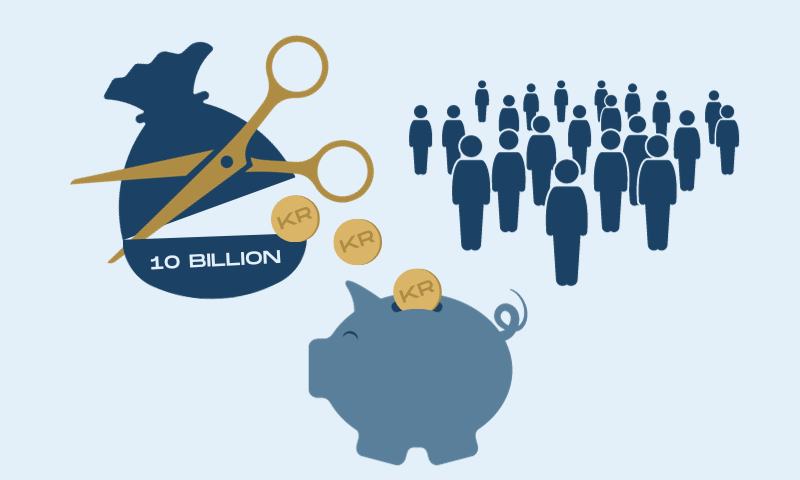
A picture showing a pair of scissors cutting a bag of money in half. The bag has text saying: "10 billion", and 3 coins are falling out of the bag and into a piggy bank. In the background a group of people is seen.

10 billion DKK yearly tax break

The Danish government has propsed a 10 billion Danish Kroner (DKK), roughly 1.3 billion EUR, tax break from 2026. The tax break will come into effect from 2026 and save Danish tax subjects an estimated 10 billion DKK yearly.

While 3.3 million Danes will receive tax breaks of said 10 billion DKK, roughly 8000 Danes will have to pay more in taxes due to the introduction of a new “top-top-tax” (top-top-skat) for persons with a yearly income of more than 2.5 million DKK.

Those who already pay top tax will be moved to a bracket of in-between tax (mellem-skat) of 7,5% instead of the current 15%. Persons who do not pay top tax will receive a yearly tax break of roughly 3000 DKK.

Before 2026

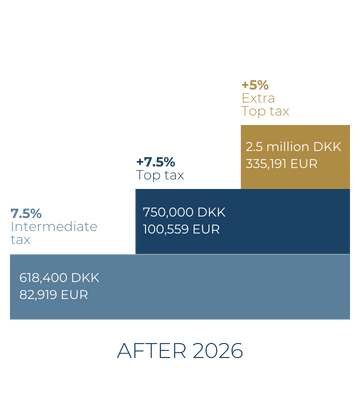
After 2026

15% top tax
618,400 DKK | 82,919 EUR

+5% extra top tax
2.5 million DKK | 335,191 EUR

+7.5% top tax
750,000 DKK | 100,559 EUR

7.5% Intermediate tax
618,400 DKK | 82,919 EUR


Link to source: The Danish Ministry of Economic Affairs (text in Danish)

A model showing the difference in tax before and after the new tax reform proposal to take effect from 2026

Link to source: The Danish Ministry of Economic Affairs (text in Danish)

Link to source: The Danish Ministry of Economic Affairs (text in Danish)

Latest news

EFTA Court clarifies when a minor activity must be disregarded in social security coordination

On the 3rd of July, 2026, the EFTA Court clarified how a minor activity should be treated when authorities decide which country’s social security system applies to a person working across borders. In Case E-26/25 the Court held that an activity generating less than 0.5% of a person’s income creates a strong presumption that it is marginal and must be disregarded, a point that matters to any employer whose staff hold an A1 certificate across two or more European Economic Area (EEA) states.

Interior of the European Parliament chamber in Strasbourg

EU agrees digital declaration system for posted workers: what it means in practice

On the 23rd of June, 2026, the European Parliament and the Council of the European Union reached a provisional agreement on a regulation establishing an EU-level digital declaration system for posted workers. The agreement is one of the first concrete outputs of the “One Europe, One Market” roadmap and is intended to reduce administrative burdens for businesses while improving enforcement of the EU Posted Workers Directive (Directive 96/71/EC, as amended by Directive 2018/957/EU).

Ask us about this topic

* We process your details solely to answer your question and retain them no longer than necessary for that purpose. See our privacy policy for your rights, including access, correction, and erasure.

Scroll to Top